Green roofs have gone from an environmental curiosity to a planning expectation in London. Many boroughs now have explicit policies requiring or encouraging green roofs on new developments, and planning committees regularly push for them on refurbishment projects as well. We have been installing green roofs for over 15 years, and this article shares what we have learned in that time.
The Real Benefits
The environmental case for green roofs in London is strong, and it is supported by measurable data.
Stormwater management is the benefit that matters most to London planners. A typical extensive green roof (80mm to 150mm substrate depth) retains 40 to 60 percent of annual rainfall, releasing the remainder slowly over hours rather than minutes. For a city with a Victorian sewer system that regularly overflows during heavy rain, this retention capacity is genuinely valuable. Thames Water and the London boroughs are actively encouraging any measure that reduces peak stormwater discharge into the drainage network.
Thermal performance improvements are measurable but modest. A green roof adds thermal mass to the building and provides some additional insulation, particularly in summer when it reduces solar heat gain. Studies have shown a 3 to 5 degree Celsius reduction in roof surface temperature on hot days. In practical terms, this translates to marginally lower cooling costs in summer and a small improvement in winter heating performance. The effect is noticeable but not transformative.
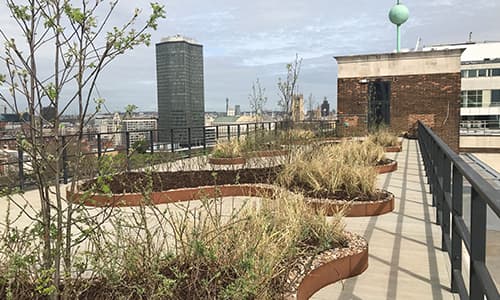
Biodiversity is a genuine and underappreciated benefit. A well-designed extensive green roof with a mix of sedum species, wildflowers, and varied substrate depths will attract bees, butterflies, beetles, and birds. In a dense urban environment where ground-level green space is limited, roof-level habitat makes a meaningful contribution. Several of our green roof installations have been colonised by species that were not part of the original planting scheme, which suggests that the habitat is genuinely functional.
Extended membrane life is a practical benefit that building owners appreciate. The green roof growing medium and vegetation protect the waterproof membrane beneath from UV radiation, temperature extremes, and mechanical damage. A waterproof membrane under a green roof will typically last 20 to 30 percent longer than an exposed membrane on the same building.
The Honest Costs
An extensive green roof (sedum mat or sedum blanket over 80 to 100mm of substrate) adds approximately 40 to 60 pounds per square metre to the cost of the roof, over and above the waterproofing system. For a 500 square metre roof, that is 20,000 to 30,000 pounds of additional cost.
An intensive green roof (deeper substrate with shrubs, perennials, and potentially small trees) costs significantly more, typically 100 to 200 pounds per square metre or more, depending on the planting specification and the structural requirements. Intensive systems also require ongoing maintenance (irrigation, pruning, replanting) that adds to the whole-life cost.
These costs need to be weighed against the benefits. The stormwater management value may be required by planning policy and therefore unavoidable. The extended membrane life has a quantifiable financial value. The biodiversity and aesthetic benefits have a less tangible but still real value for building occupants and neighbours.
What We Have Learned
Waterproofing quality is everything. The single most important factor in a successful green roof is the quality of the waterproofing system beneath it. Once the growing layers are in place, locating and repairing a membrane failure is extremely expensive and disruptive. You have to remove the vegetation, substrate, drainage layers, and filter fleece just to access the membrane. Then you have to reinstate the lot after the repair.
This is why we insist on using proven waterproofing systems from manufacturers who specifically warrant their products for green roof applications. We carry out rigorous flood testing (filling the contained roof area with water and monitoring for 48 hours) before any growing layers are installed. In over 15 years of green roof installation, we have had zero waterproofing failures attributable to our work.
Substrate depth matters. The minimum 80mm substrate depth that some specifications allow is, in our experience, the bare minimum for plant survival through a dry London summer. We recommend 100 to 120mm for extensive green roofs, which provides a better moisture reserve and supports a wider range of species. The additional cost for the extra 20 to 40mm of substrate is modest compared to the risk of a green roof that turns brown and dies in August.
Plant selection should be local. Sedum species are the backbone of extensive green roofs because they tolerate drought, frost, and poor soil. But not all sedum varieties perform equally well in London conditions. We work with specialist green roof nurseries who grow plants adapted to the UK climate, and we have found that locally grown plant material establishes better and survives longer than imported alternatives.
Maintenance is not optional. Even extensive green roofs, which are marketed as low maintenance, need at least two inspections per year. Outlets must be kept clear of debris. Invasive weeds (buddleia is a particular problem in London) must be removed before they establish. Dead or patchy areas may need replanting. Neglecting maintenance does not kill the green roof immediately, but it degrades performance over time.
Structural assessment cannot be skipped. Green roofs add load to the building structure. A saturated extensive green roof weighs approximately 80 to 120 kg per square metre. An intensive system can weigh 300 kg per square metre or more. The structural capacity of the building must be assessed by a qualified structural engineer before any green roof is specified. On new builds, this is straightforward. On existing buildings, especially older ones, it may require strengthening works that add to the project cost.
Planning and Specification
If you are considering a green roof for a new development or an existing building in London, we are happy to discuss the options. We can assess the structural capacity, recommend the most appropriate system and planting specification, provide a detailed quotation, and manage the installation from waterproofing through to planting.
Contact our Blackheath office to arrange a consultation.