School roofing projects are among the most rewarding work we do, and also among the most carefully managed. The combination of occupied buildings, safeguarding requirements, holiday-period working constraints, and public sector accountability means that school roofing demands a level of planning and professionalism that goes well beyond the technical roofing work itself.
We have been working on school buildings across London and Kent for over four decades. Our project portfolio includes primary schools, secondary schools, academies, sixth form colleges, and special educational needs facilities. This article shares what we have learned about making school roofing projects successful.
The Holiday Window
Most school roofing work needs to be completed during school holidays, typically the summer break (six to seven weeks) or the Easter and half-term breaks (one to two weeks each). This creates a compressed programme that requires careful planning and reliable execution.
For a summer holiday re-roofing project, our planning starts months before the break begins. Materials are ordered and stored off-site. Scaffolding is erected during the last week of term (on areas away from pupil circulation routes) or on the first day of the holidays. The roofing works then proceed on an accelerated programme with extended working hours if necessary. We build contingency into the programme for weather delays, because a re-roofing project that is not weathertight when the pupils return in September is not an acceptable outcome.
For smaller projects (isolated flat roof repairs, gutter replacement, fascia and soffit renewal), it is sometimes possible to work during term time, provided the work area can be isolated from pupil and staff circulation. We discuss these options with the school at the planning stage and agree a method that maintains both safety and educational continuity.
Safeguarding and DBS Requirements
Every person who enters a school site needs to be vetted. All Capital Roofing operatives who work on school projects hold current DBS (Disclosure and Barring Service) checks. We maintain a register of DBS-checked personnel and can provide copies of certificates to the school on request.
On site, our teams work within clearly defined and fenced areas, with no unsupervised access to areas where pupils are present. During term-time working, the boundary between the works area and the school environment is maintained with Heras fencing, clear signage, and a controlled access point.
Noise, Dust, and Disruption
Roofing work generates noise, particularly when stripping existing coverings and cutting materials. During term-time working, we schedule the noisiest operations for times that do not coincide with examinations, assemblies, or quiet teaching periods. We discuss the programme in detail with the school facilities manager and head teacher to identify any particular sensitivities.
Dust control is managed through damping down, use of enclosed cutting stations, and prompt clearance of debris. We leave the site clean and tidy at the end of every working day, with materials stacked neatly and all debris removed. This is important in a school environment where the appearance and safety of the site is constantly observed by parents, governors, and Ofsted inspectors.
Health and Safety on School Sites
Our health and safety record speaks for itself: we have held the NFRC Gold Safety Award every year since 2004, a run of 20 consecutive years. On school projects, the standard safety requirements (scaffolding, edge protection, safe access, PPE, method statements, risk assessments) are supplemented by school-specific measures.
These include: specific risk assessments for working near occupied classrooms; vehicle movement plans that account for pupil drop-off and pick-up times; secure storage of tools and materials at the end of each day; and emergency procedures coordinated with the school office and the facilities manager.
We provide a named project manager for every school roofing project, and that person is the single point of contact for the school throughout. Any concerns or questions are addressed immediately, not put into a queue.
Funding and Procurement
School roofing projects are typically funded through the Condition Improvement Fund (CIF), Devolved Formula Capital (DFC), local authority capital programmes, or the academy trust capital budget. Each funding route has its own procurement rules, and we are familiar with all of them.
For CIF-funded projects, we can assist with the initial condition assessment and cost estimate that forms part of the funding application. Our drone survey reports provide the detailed evidence of roof condition that the Education and Skills Funding Agency (ESFA) requires.
For competitively tendered projects, we submit detailed technical proposals that demonstrate our understanding of the project, our proposed methodology, and our relevant experience. We welcome the rigour of a competitive process because it allows us to demonstrate the value we bring.
Case Study: Bromley High School
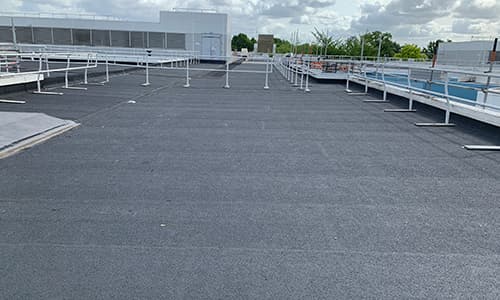
One of our most recognised school projects was the refurbishment of Bromley High School, which won the FRA Best Refurbishment Project (up to 1000 square metres) award in 2004. The project involved replacing the deteriorated flat roof covering on the main school building during the summer holiday period. The programme was tight, the access was constrained, and the weather was uncooperative. Our team completed the work on time, within budget, and to a standard that the judging panel considered the best in the country that year.
That project was over 20 years ago, but it remains a good example of what we bring to school roofing work: careful planning, skilled execution, and a determination to deliver quality even when the constraints are challenging.
Getting Started
If your school needs roofing work, the first step is an assessment of the current roof condition. We offer free drone surveys and site inspections for schools in London and the South East. The assessment report can support CIF applications, inform capital budgets, and provide the technical basis for a procurement exercise.
Contact our Blackheath office to arrange a survey at a time that suits the school calendar.