When we first started using drones for roof inspections several years ago, the technology was a useful novelty. Today it is a standard part of our workflow. We use drones on a significant proportion of our survey work, and for property managers with large portfolios, the cost and time savings are substantial.
This article explains how drone roof surveys work, what they can tell you, what they cannot tell you, and when they are the right choice for your building.
How a Drone Roof Survey Works
Our drone operators are CAA (Civil Aviation Authority) approved and carry the necessary certifications and insurance for commercial drone flights. Before every survey, we carry out a site-specific risk assessment that covers airspace restrictions, proximity to airports, overhead cables, trees, and neighbouring properties. In some parts of London, particularly near Heathrow, City, and Biggin Hill airports, we need to coordinate with air traffic control.
The drone carries a high-resolution camera that captures detailed imagery of every part of the roof surface. The operator flies a planned pattern that covers the entire roof area, capturing overlapping images that can be stitched together into a comprehensive overview. On larger buildings, we fly multiple passes at different altitudes to capture both wide-angle context and close-up detail.
The whole process typically takes 30 to 60 minutes for a standard commercial building. For a multi-block housing estate, a full day of flying can cover an area that would take weeks to inspect from scaffolding.
What Drone Surveys Can Detect
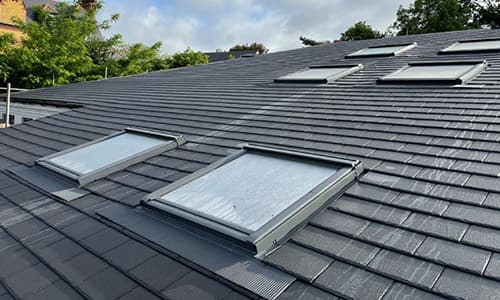
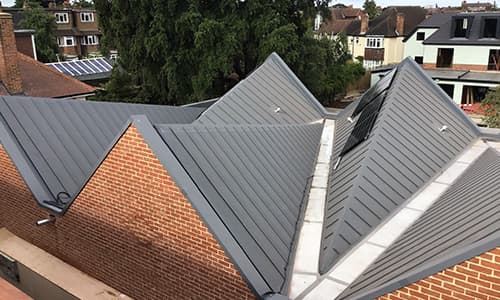
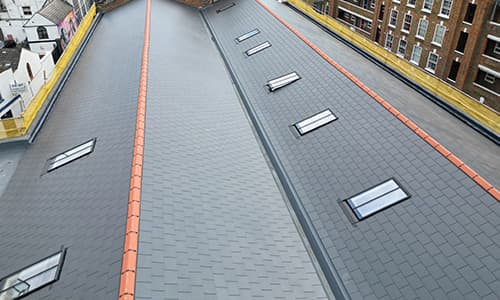
High-resolution aerial imagery is remarkably effective at identifying common roofing defects. On pitched roofs, we can identify: slipped, cracked, or missing tiles and slates; deteriorated ridge and hip mortar; damaged or missing lead flashings; blocked or broken gutters; moss and vegetation growth; damaged chimney stacks and pots; and deteriorated fascias, soffits, and bargeboards.
On flat roofs, the drone imagery reveals: ponding (standing water that indicates inadequate drainage); split, blistered, or debonded membrane; deteriorated upstands and perimeter details; blocked outlets; mechanical damage from foot traffic or falling objects; and vegetation growth that indicates moisture retention.
The images are clear enough to assess the general condition of roofing materials, estimate remaining service life, and prioritise repair or replacement work. For property managers who need to survey dozens or hundreds of buildings, this is transformative. What previously required scaffolding, cherry pickers, or ladder access at every building can now be accomplished from the ground in a fraction of the time.
What Drone Surveys Cannot Detect
Drone surveys have limitations, and it is important to understand them. A drone captures what is visible from above. It cannot see beneath the roof covering, and it cannot assess the condition of the roof structure, the insulation, or the internal side of the roof.
Specifically, drone surveys cannot detect: rot or deterioration in roof timbers; wet or compressed insulation; condensation issues in the loft or roof void; the condition of underlay or vapour control layers; internal water staining (though this may indicate a leak location); or the structural integrity of the roof frame.
If there are signs of water ingress to the building interior, or if the building is old enough that structural deterioration is a concern, a physical inspection is still necessary. In these cases, the drone survey serves as a first step: it identifies the areas of concern on the exterior, so that any scaffolding or access equipment can be targeted to specific locations rather than the entire building.
When Drone Surveys Make Financial Sense
Drone surveys are most cost-effective in the following situations:
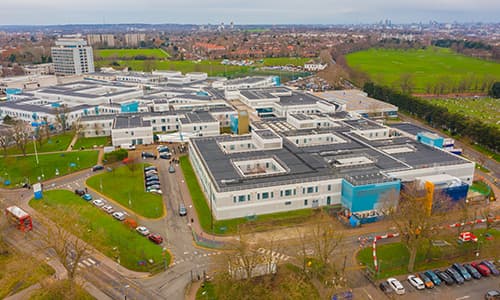
Large buildings with extensive roof areas. Scaffolding an entire warehouse, school, or office building for an inspection survey is expensive. A drone survey can provide equivalent visual information at a fraction of the cost.
Portfolio assessments. Property managers who need to assess the roofing condition across multiple buildings (such as a housing association with an estate of 50 blocks) can survey the entire portfolio in days rather than months, with proportionate cost savings.
Pre-purchase due diligence. Before acquiring a commercial property, a drone survey provides a rapid, cost-effective assessment of the roof condition that can inform the purchase negotiation and help budget for future maintenance.
Insurance claims. After storm damage, drone imagery provides documented evidence of roof condition that supports insurance claims. We can typically attend within 24 to 48 hours of a storm event.
Regular condition monitoring. Annual or biannual drone surveys create a time-series record of roof condition that helps property managers track deterioration and plan maintenance proactively rather than reactively.
Drone surveys are less cost-effective for small domestic properties where a visual inspection from a ladder provides sufficient information, or for situations where the investigation needs to include the roof structure and interior spaces.
The Survey Report
After every drone survey, we produce a written report that includes: annotated photographs identifying specific defects; an overall condition assessment with a rating for each roof area; estimated remaining service life for each roof covering; prioritised recommendations for repair or replacement; budget estimates for the recommended works; and a comparison with any previous survey data.
This report is designed to give property managers the information they need to make decisions and allocate budgets. It is clear, practical, and free of unnecessary jargon.
Commissioning a Drone Survey
If you manage commercial or residential property in London or the South East and would like to discuss a drone roof survey, contact our office in Blackheath. We can typically schedule surveys within one to two weeks and deliver the report within five working days of the flight.
For portfolio assessments, we offer volume pricing that makes the cost per building very competitive with any other survey method.